
How to Read an Appliance Error Code (And What to Do With It)
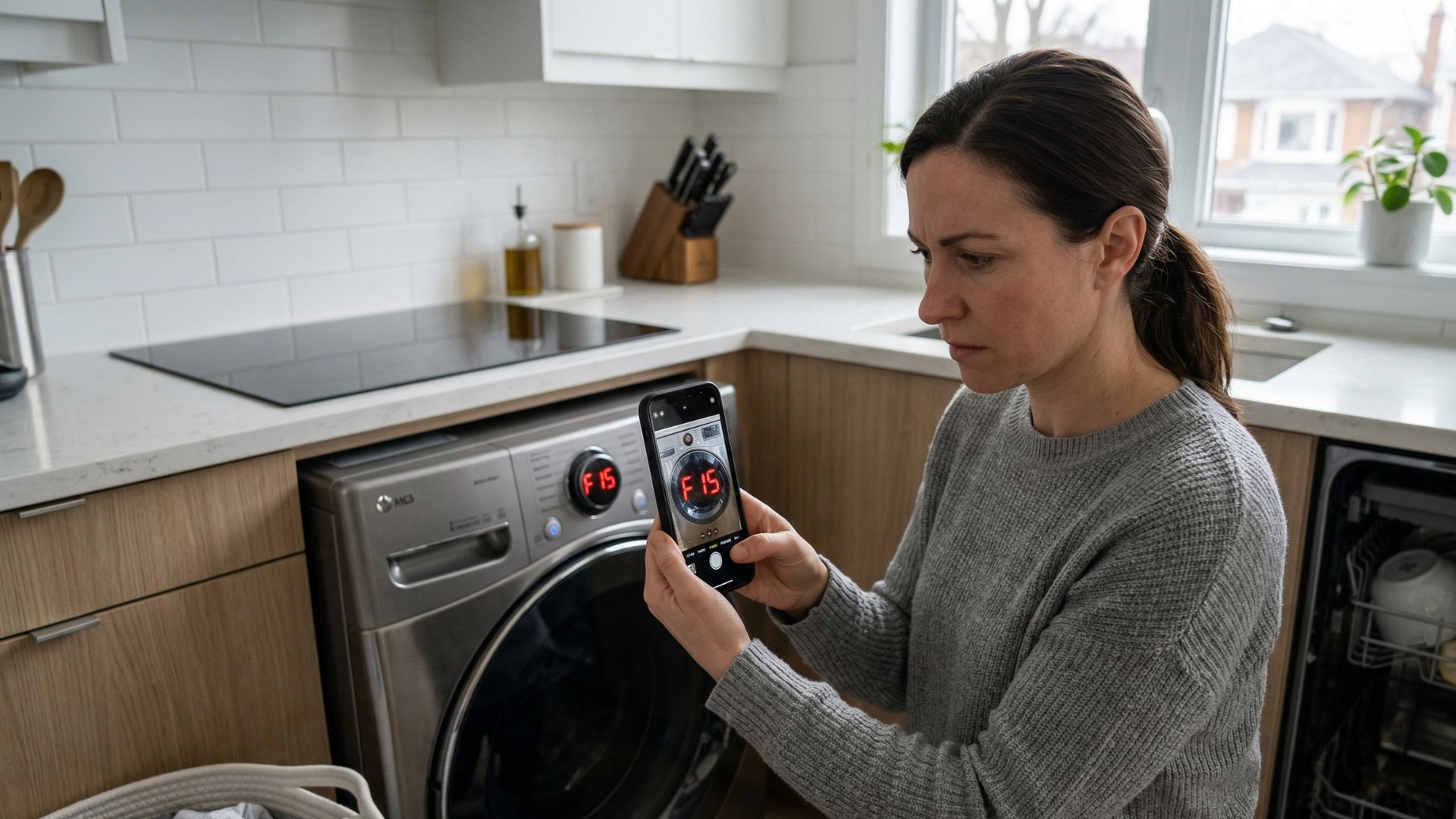
Your appliance flashes a code you have never seen before and stops working. You take a photo of the display and type the code into a search engine. You get 47 different results, half of which are for the wrong model, and none of which tell you clearly what to actually do next. Error codes are genuinely useful diagnostic information, but only if you understand how they work and what they are actually telling you.
What Error Codes Actually Are
Modern appliances contain control boards that continuously monitor sensors throughout the machine: temperature sensors, water level sensors, motor speed sensors, door latch sensors, pressure sensors, and more. When a sensor reading falls outside a normal range, or when a component fails to respond to a command within an expected time, the control board flags the condition and displays a code.
The code is not a diagnosis. It is a symptom. A code that means “water is not draining” does not tell you whether the pump has failed, the filter is clogged, the drain hose is kinked, or the control board has sent a false reading. It tells you that the control board detected an abnormal drainage condition. The actual cause still needs to be determined, which is why searching a code and reading “replace the pump” is often premature.
How Code Systems Are Structured
Most manufacturers use a consistent logic in how their codes are structured, though the specific codes differ between brands and even between product lines within the same brand.
| Brand | Code format | General logic |
|---|---|---|
| Samsung | Letters followed by numbers (e.g. E3, 5E, 4C) | Letter prefix often indicates the system (E for error, 4 for water, 5 for drain), number indicates specific fault within that system |
| LG | Two letters (e.g. LE, OE, UE, DE) | Letters typically stand for the issue area: LE = locked motor error, OE = outlet/drain error, UE = unbalanced error, DE = door error |
| Bosch | E followed by two digits (e.g. E09, E17, E24) | Numbers are grouped: E09-E19 typically relate to heating, E20-E29 to drainage, E30+ to other systems depending on the appliance type |
| GE | F followed by a number, sometimes with a sub-code (e.g. F3, F7 E1) | F codes indicate the general fault category, E sub-codes indicate the specific component or condition within that category |
| Whirlpool / Maytag / KitchenAid | F and E codes combined (e.g. F5 E1) | These brands share a common code architecture. F indicates the fault type, E indicates the specific error within that type |
The Most Common Codes and What They Usually Mean
While the specific code varies by brand, certain categories of fault show up far more often than others. These are the codes most homeowners encounter.
One of the most common codes across all appliance types. It means the machine detected that water was not removed within the expected time. Before calling a technician, check whether the filter is blocked (dishwashers and washing machines), whether the drain hose is kinked or not seated properly, and whether the sink or standpipe it drains into is itself blocked. A surprisingly large percentage of drain error calls resolve with a filter clean. Our guide on why dishwashers stop draining in South Florida covers the full diagnostic process.
The machine could not reach the target temperature within the expected time, or the temperature sensor returned a reading outside the normal range. This can indicate a failed heating element, a failed temperature sensor, or in South Florida specifically, a machine that is being asked to heat water in an environment where the incoming water is very warm and the sensors are reading differently than calibrated. A technician can distinguish between a genuine component failure and an environmental reading anomaly quickly.
The machine cannot confirm the door is properly latched. This is sometimes a genuine latch or switch failure, but it is also commonly caused by a door seal that has become deformed and prevents the door from closing fully, or by debris caught in the door frame. Check the door seal for damage or obstruction before concluding the latch mechanism has failed.
Common in washing machines. The motor could not achieve the required speed, or something stopped it from turning freely. Before assuming a motor failure, check whether the load is severely unbalanced (a single heavy item shifting the drum), whether there is a foreign object caught between the drum and the tub (coins and bra wires are the most common culprits), and whether the machine is level. Many motor error codes on washing machines resolve with a redistribution of the load.
The control board cannot communicate with one of the machine’s sub-modules. This is one of the harder codes to self-diagnose because it can mean a failed control board, a failed sub-module, or simply a loose wiring connection that was disrupted by vibration over time. A power reset (unplug for 60 seconds) sometimes clears a communication error that was triggered by a temporary condition. If the error returns, a technician is needed.
The First Step Before Anything Else: Reset
When any error code appears for the first time, the first thing to do is reset the appliance. Unplug it from the wall (or switch it off at the circuit breaker for built-in appliances), wait 60 seconds, and restore power. A meaningful proportion of error codes are triggered by temporary conditions, power fluctuations, or sensor glitches that clear completely after a power cycle.
If the same code returns immediately or within the next cycle, you have a genuine fault that needs investigation. If it does not return for several cycles but comes back later, you have an intermittent condition that is worth monitoring and noting down, including when it occurs and under what cycle conditions.
When to Call a Technician
Call a technician when the code returns after a reset, when the code indicates a system you cannot safely access (electrical, refrigerant, gas), or when the appliance stops working and the code alone does not point to anything you can check yourself. Providing the technician with the exact code, the model number, and a description of when and how often the code appears gives them a significant head start on the diagnosis and typically shortens the visit.
Error Code That Is Not Clearing?
Our technicians diagnose error codes across all major appliance brands in Miami-Dade, Broward, and Palm Beach County. Tell us the code and the model when you call and we can often identify the likely cause before we even arrive.
Error codes are tools, not answers. They narrow down the search space considerably, but they do not tell you which specific component has failed or why. The right approach is to use them as a starting point: reset first, check the obvious related things second (filter, drain, door seal, load balance), and call a technician when those steps do not resolve it. Taking a photo of the code and noting the exact sequence of events that preceded it is the most useful thing you can do before that call.
Need a hand with this? Our technicians cover Miami-Dade, Broward and Palm Beach with same-day service and a free service call when you book the repair. See appliance repair in Miami, our service area, or call (786) 733-9343.
Further reading: U.S. Consumer Product Safety Commission.