
The Top 5 Appliance Fire Hazards Lurking in Miami Homes
The most common appliance fire hazards in a Miami home are not exotic. They are routine, fixable in 20 minutes, and they show up on every dryer repair service call we run during summer storm season. Lint in a dryer vent. A microwave run empty. A power cord daisy-chained through a surge strip. Per the National Fire Protection Association, U.S. fire departments respond to roughly 358,500 home structure fires every year. Cooking equipment causes about 50 percent of them. Dryers cause another 13,820. And the leading factor on both is preventable.
This guide is a Miami-specific look at the five appliance fire hazards that show up most often in South Florida homes, what the NFPA and U.S. Fire Administration data actually say, and a 5-minute checklist you can run today. The information here is general guidance. Anything involving electrical work, gas connections, or signs of damage to a unit should be left to a licensed Florida professional.
In this article
- What the fire data actually shows
- Hazard 1, the dryer vent line
- Hazard 2, the unattended cooktop
- Hazard 3, the microwave running on a worn turntable or with metal
- Hazard 4, the refrigerator condenser and wiring
- Hazard 5, power cords and outlet load
- What to do in the next 30 minutes
- Frequently asked questions
What the fire data actually shows
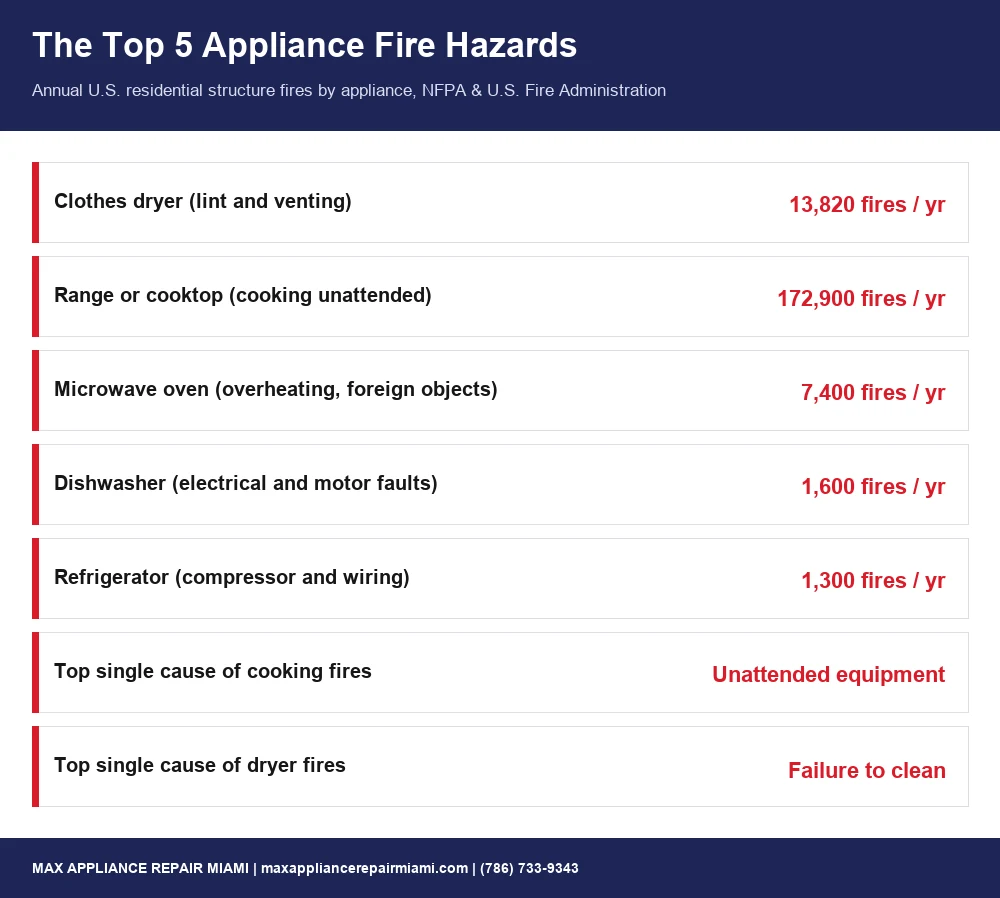
Cooking equipment is the leading cause of all home structure fires in the United States, according to U.S. Fire Administration residential fire statistics. Roughly 172,900 home cooking fires happen every year. Unattended equipment is the single largest factor.
Clothes dryers are the second appliance category by fire count. National Fire Protection Association data on home cooking fires attributes most of them to a dryer that has not had its lint trap or vent line cleaned. Failure to clean is the No. 1 cause. Mechanical failure is a distant second.
Miami sees an additional layer of risk that interior U.S. cities do not. Salt air corrodes wiring on coastal homes faster. Hurricane-season power surges are harder on control boards. The summer humidity load makes refrigerator and freezer compressors run hotter for longer. None of those are fire causes on their own. They are accelerators of the routine wear that eventually creates a fire condition.
| Hazard | Annual U.S. fires | Top cause | Fix time at home |
|---|---|---|---|
| Cooktop and range | 172,900 | Unattended cooking | Habit change, no tools |
| Clothes dryer | 13,820 | Failure to clean | 15 to 30 minutes |
| Microwave | 7,400 | Running empty or with metal | 5 minutes |
| Dishwasher | 1,600 | Motor or wiring fault | Service call only |
| Refrigerator | 1,300 | Condenser dust and wiring | 15 minutes |
Source: National Fire Protection Association and U.S. Fire Administration, 2024 statistics.
Hazard 1, the dryer vent line
This is the single biggest one and it is also the easiest to fix. The lint trap inside the dryer catches roughly 60 to 70 percent of fibers. The other 30 to 40 percent goes through the vent line, builds up over months, and eventually creates a fire condition behind the wall.
A typical Miami dryer vent should be cleaned once a year. If your dryer takes more than 50 minutes to dry a full load, or the room around the dryer is hotter than the rest of the laundry area, the line is restricted. The repair is a $90 to $180 service call. The risk is a five-figure house fire.
The vent material matters
If the duct between your dryer and the exterior wall is white plastic or vinyl, replace it. The plastic sags, traps lint at every dip, and is more flammable than rigid metal. The fix is to swap to rigid or semi-rigid aluminum duct. NFPA and the U.S. Fire Administration both flag the plastic flexible duct as a confirmed fire risk. Most newer Florida builds already use metal, but homes built before 1995 often still have the plastic version.
What a clean dryer line looks like
After a service or DIY clean, you should see no lint accumulation in the first 4 feet of the duct, no kinks or sharp bends, and no signs of heat scoring on the duct walls. The exterior vent flap should open freely when the dryer runs. If your dryer pushes lint out the back instead of through the vent, the line is fully blocked and the dryer is venting back into the house. That is an immediate problem, not a future one.
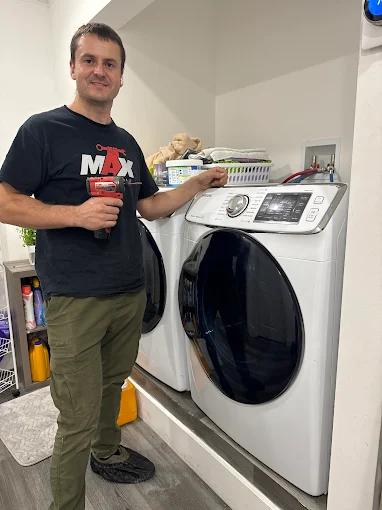
A Max technician checks an dryer for lint buildup in Aventura.
How often should I clean my dryer vent in Miami?
Once a year is the minimum. Twice a year is better in households that run the dryer daily or that have a vent line longer than 25 feet. Miami’s humidity makes lint cling more readily to the duct walls, so the cleaning interval should be tighter than the national average.
Hazard 2, the unattended cooktop
Unattended cooking equipment is the leading factor in home cooking fires. The U.S. Fire Administration reports that more than half of all kitchen fires start because someone left the room. Most of those happen on the stovetop, not in the oven. A pan of oil at 400 degrees Fahrenheit can flash to a fire in 30 to 90 seconds.
The fix is a habit, not a part. If you must leave the kitchen, turn the burner off. The energy cost of restarting a burner is rounding error compared to the cost of a kitchen fire. Newer ranges, including Wolf, GE, and Bosch units, ship with auto-shutoff features. Verify yours is enabled and tested.
The risk to high-end ranges
For homeowners with a Wolf, Viking, or Thermador range, the additional risk is the heat-retention design. These ranges hold heat longer than budget units, and a residual-heat fire on a turned-off burner is a documented event. If the cooktop is hot, treat it as live for 15 minutes after the last burner is shut off. Service-side, a worn-out igniter or a sticking burner valve is a $350 to $850 repair on most luxury ranges. Worth booking before it becomes the cause of an event. Range repair service in Miami typically responds same-day.
“Pulled the dryer out today for the first time in 4 years. The vent was almost completely blocked with lint. The wall behind it was warm to the touch. I had no idea this was a thing.”
r/HomeImprovement homeowner, 2024
Did you know?
The NFPA reports that 33 percent of home dryer fires happen because the vent has not been cleaned. That is the single largest factor across the entire dataset. Mechanical failure, electrical issues, and operator error are all far behind.
Hazard 3, the microwave running on a worn turntable or with metal
Microwave fires account for roughly 7,400 home fires per year. Most start with one of three causes: running the unit empty, putting metal inside, or food residue burning on the cavity walls. The first two are user-side. The third is maintenance.
Wipe down the inside of the microwave once a week. Burned-on food residue lights more readily than people expect. If the unit makes any popping, arcing, or sparking sound during normal use, unplug it and stop using it. A bad waveguide cover or a worn-out magnetron is a confirmed fire risk and the unit is at end of life. A microwave repair tech can diagnose and replace these parts in a single visit.
Built-in microwaves above ranges need extra attention
Over-the-range microwaves take more abuse than countertop units. Steam, grease, and heat from the cooktop below shorten their life. Inspect the underside vent and grease filter monthly. A clogged grease filter is a fire condition the manufacturer rates at high risk. Replacement filters run $20 to $40, fit most major brands, and take 5 minutes.
Safety note: The information in this guide is general homeowner advice based on NFPA and U.S. Fire Administration data. It is not a substitute for professional inspection. Anything involving electrical work, gas connections, scorch marks, or signs of damage to a unit should be left to a licensed Florida professional. In an active fire emergency, leave the home and call 911 first. The Florida Department of Business and Professional Regulation licenses electrical and gas contractors statewide.
Save your money
Before you book a dryer service call, run the lint trap cleaning and visual vent check yourself. Most dryer airflow problems are downstream of a $0 fix. Only call a tech if the airflow is still restricted after the trap and accessible duct are clear.
Hazard 4, the refrigerator condenser and wiring
Refrigerator fires are rare, about 1,300 a year in the United States, but they happen for a specific reason. The compressor and the condenser coils on the back or underside of the unit accumulate dust over time. In Miami, that dust binds with humidity and creates a slow-burn risk.
Pull the fridge out from the wall once a year. Vacuum the condenser coils with a brush attachment. Check that the power cord is not pinched against the wall. Confirm the unit is plugged directly into the outlet, not through a power strip. The whole job takes 15 minutes and prevents a category of fire that mostly goes unnoticed until it is well underway.
Older built-in refrigerators are a separate conversation
Built-in fridges, including Sub-Zero and Viking units, push warm air through a top-mounted grille. That grille gathers dust faster in Miami than in drier climates. A clogged grille forces the compressor to run hotter, which is the fire condition. Sub-Zero appliance repair calls in Coral Gables and Pinecrest typically include a grille cleaning at no additional charge during a service visit. Worth asking for if you have not had one in 18 months.
Pro tip
Set a calendar reminder for the same date every spring. “Fire safety check” should take you 30 minutes and cost nothing. Pair it with the smoke-alarm battery swap and the AC filter change you already do. The habit is the protection.
Hazard 5, power cords and outlet load
Daisy-chained extension cords and overloaded outlets are the most preventable category. NFPA tracks them as a leading factor in electrical fires, which account for about 13 percent of all home fires.
The rule is simple. High-draw appliances, including dryers, microwaves, toaster ovens, and window air conditioners, plug directly into the wall outlet. Not into a power strip. Not into an extension cord. Each of those appliances pulls 1,200 to 1,800 watts when running, and the connection points on a power strip are not rated for that continuous load.
Surge protection is a separate question
South Florida’s summer storm season produces more power surges than most U.S. regions. A whole-home surge protector at the panel, installed by a licensed electrician, is the right answer for protecting your appliances and your wiring. Plug-in surge strips do not handle the kind of transient that takes out a control board on a Sub-Zero or a Wolf range. The whole-home unit runs $300 to $700 installed and is a one-time cost.
What to do in the next 30 minutes
You do not need a service call to handle four of the five hazards on this list. Tonight, in 30 minutes, you can cover most of the risk surface. The order matters.
- Pull the dryer out, disconnect the vent, and check for lint accumulation. If the duct is plastic, plan to replace it.
- Wipe out the microwave. Check the grease filter on any over-the-range unit.
- Pull the fridge out and vacuum the condenser coils or the top grille.
- Walk around the kitchen and laundry. Confirm dryers, microwaves, toaster ovens, and window AC units are plugged directly into the wall, not through a power strip.
- Test every smoke alarm in the house. Replace any battery older than 6 months. Replace any unit older than 10 years.
The fifth hazard, electrical load, is a longer-term project. If your home was built before 1995 and has not had a panel inspection in the past 10 years, that is the right next call to a licensed electrician. The state of Florida licenses electrical contractors through the Department of Business and Professional Regulation. Verify the licence at the Florida DBPR site before any work begins.
Take this with you
A printable PDF version of The Top 5 Appliance Fire Hazards Lurking in Miami Homes, ready for the fridge or the laundry-room wall.
Download the 5-minute fire safety checklist (PDF)Max Appliance Repair Miami runs dryer-line inspections and full appliance safety checks across Doral, Aventura, Hialeah, Kendall, Coral Gables, and the wider Miami-Dade and Broward area. Same-day service is available year-round. Call (786) 733-9343 or request an appliance safety check. The diagnostic call is waived if you book a repair.
Frequently Asked Questions
How often should I clean my dryer vent in Miami?
Once a year is the minimum for a typical household. Twice a year is appropriate for high-use homes or for vent lines longer than 25 feet. Miami’s humidity and salt air shorten the safe cleaning interval slightly compared to drier U.S. cities.
Are dryer fires really as common as people say?
Yes. The U.S. Fire Administration and NFPA both report roughly 13,820 dryer-related home fires per year, with 33 percent caused by failure to clean the vent. The data is consistent across the past decade.
Can a refrigerator actually start a fire?
Yes, though it is rare. Most refrigerator fires start with dust on the condenser coils or with worn power-cord insulation. Miami homes accumulate condenser dust faster because of humidity. Annual coil cleaning eliminates most of that risk.
Should I unplug my microwave when not in use?
Not necessary in normal use. Modern microwaves draw less than 5 watts in standby. Unplug only if the unit shows signs of damage, has popped a breaker, or you are leaving the home for an extended period during hurricane season.
What is the most fire-prone appliance in a Miami home?
By annual U.S. fire counts, the cooktop and range is the most fire-prone, with 172,900 home fires per year, almost entirely from unattended cooking. The dryer is second by count and first by structural damage per fire.
Do I need a smoke alarm in the laundry room?
Florida residential code requires smoke alarms in every sleeping area and in the hallway outside sleeping areas. The laundry room is not strictly required, but a heat detector or interconnected smoke alarm in the laundry room is strongly recommended given the dryer-fire data.
The first four hazards on this list cost nothing to fix tonight. The fifth, electrical load and surge protection, is worth a conversation with a licensed Florida electrician. If you find anything during your check that looks beyond a routine clean, including scorch marks, melted plastic, or a hot spot on the wall, call Max Appliance Repair Miami. Same-day diagnostic, written quote before any work, and a 3-month warranty on every repair.