
The Appliance Maintenance Checklist South Florida Homeowners Actually Need
Every appliance manual includes a maintenance schedule. The problem is that those schedules are written for average conditions, and South Florida is not average. The combination of year-round heat, persistent humidity above 75%, and hard water in Miami-Dade and Broward County means your appliances need attention more frequently than the manual assumes. This checklist reflects what actually makes sense here, adjusted for the local environment, based on the failure patterns we see repeatedly across homes in this region.
Why the Standard Schedule Is Not Enough Here
A dryer vent cleaning schedule that is appropriate for Denver is not appropriate for Hollywood or Coral Gables. Humid air makes lint heavier and stickier, which means it accumulates in vents significantly faster. A fridge coil cleaning interval that works in a 65-degree climate is inadequate when your kitchen ambient temperature runs at 76 degrees year-round. A dishwasher descaling schedule written for soft water cities does not account for what Broward County water does to a spray arm in 90 days.
The adjusted intervals below are not conservative estimates. They reflect what we see in practice when appliances are well-maintained versus when they follow standard manual guidance. Our broader post on how Miami’s climate affects every home appliance differently explains the reasoning behind each of these adjustments in detail.
After Every Single Use
| Task | Appliance | Why it matters here |
|---|---|---|
| Clean the lint trap | Dryer | Humid air causes lint to compact faster and reduces airflow more quickly than in dry climates |
| Wipe and purge the steam wand | Coffee machine | Milk residue hardens within hours in warm temperatures. A 30-second wipe prevents full blockages |
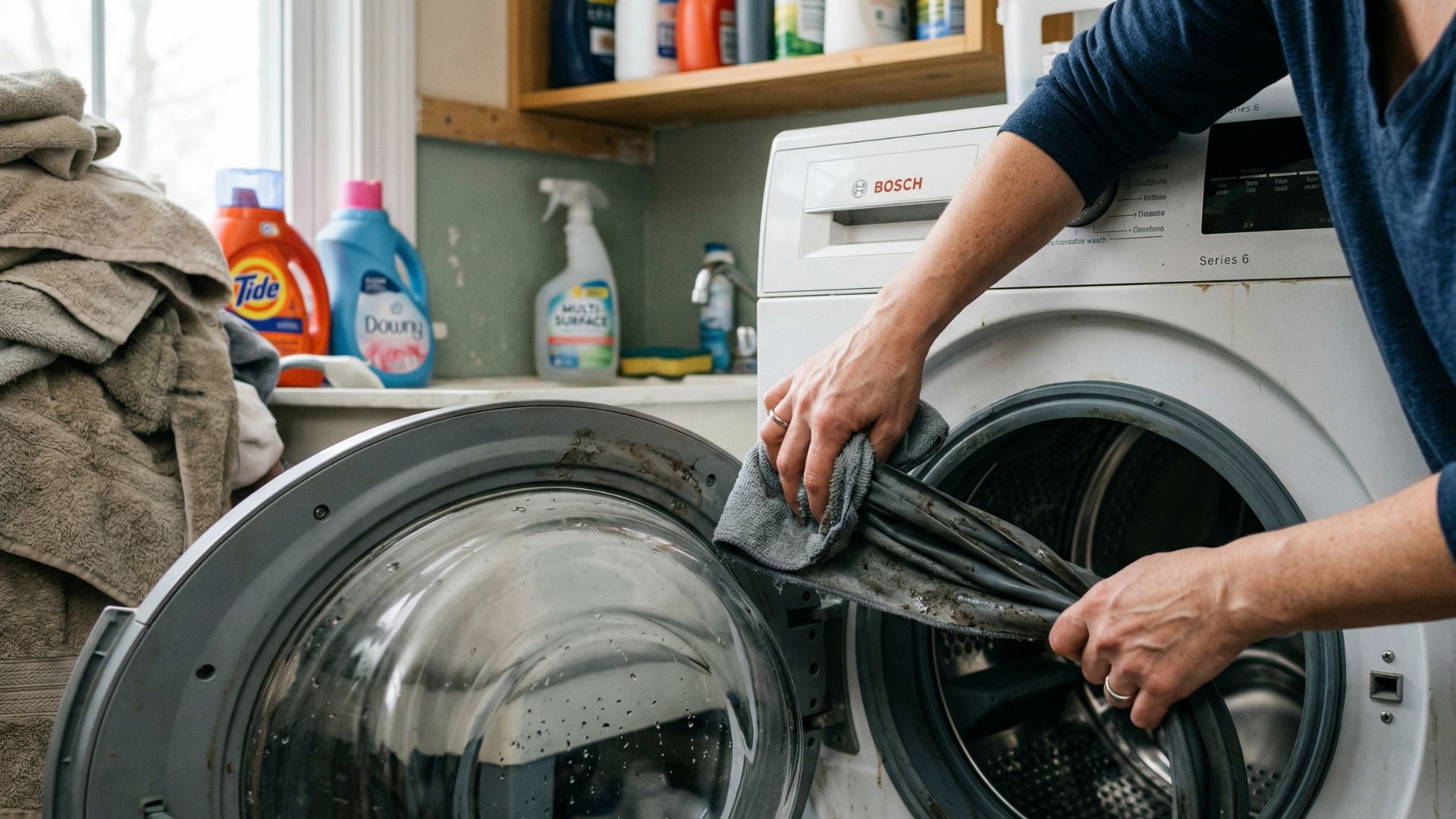
| Wipe the door seal dry | Front-load washer | Humidity means trapped moisture in the gasket folds does not evaporate naturally. Mold follows within days |
| Leave the washer door open after cycle | Front-load washer | Allows drum to air out. Critical in this climate where sealed humid environments grow mold faster than anywhere else in the country |
Weekly
| Task | Appliance | South Florida note |
|---|---|---|
| Deep clean and dry the door seal folds | Front-load washer | The daily wipe handles surface moisture. Weekly get into the folds with a cloth |
| Backflush the group head | Espresso machine | Oil and coffee residue accumulates faster with high daily use in warm kitchens |
| Wipe condenser coils exterior | Wine cooler / mini fridge | Dust and pet hair accumulate faster with constant AC use and settling particulates |
| Check fridge drain pan in summer months | Refrigerator | June through September humidity levels can fill the drain pan faster than it evaporates, leading to overflow and floor leaks |
Monthly
| Task | Appliance | South Florida note |
|---|---|---|
| Clean the filter | Dishwasher | Standard guidance says every 1 to 2 months. Monthly is right for daily use in this water |
| Run a descaling cycle | Dishwasher | Standard guidance says every 3 months. Hard local water warrants monthly descaling |
| Run a hot cleaning cycle | Washing machine | Removes the mold and mildew buildup that humidity makes inevitable in this climate |
| Clean spray arms and check holes | Dishwasher | Hard water blocks spray arm holes faster than the standard 3-month interval assumes |
| Test fridge door seal (paper test) | Refrigerator | Close door on a piece of paper. If it slides freely, the seal is not doing its job and warm humid air is entering constantly |
Every 6 to 8 Weeks
This interval exists specifically for South Florida. Most maintenance guides do not include a 6-to-8-week task list because most climates do not need one. Local hard water and humidity create a category of maintenance that needs to happen more often than monthly tasks but not as often as weekly ones.
| Task | Appliance |
|---|---|
| Full descale cycle | Coffee machine (standard guidance is every 3 months. Local water warrants every 6 to 8 weeks) |
| Refill rinse aid and check dispenser setting | Dishwasher (hard water requires rinse aid setting higher than the factory default) |
Every 6 Months
| Task | Appliance | Standard guidance vs South Florida |
|---|---|---|
| Clean full vent hose and exterior flap | Dryer | Standard: once a year. South Florida: every 6 months minimum, every 3 for daily-use households |
| Vacuum condenser coils | Refrigerator | Standard: once a year. South Florida: every 6 months. AC systems push fine particulates onto coils faster |
| Replace water filter | Refrigerator (if fitted) | Standard: every 6 months. South Florida: same interval applies, but do not go longer |
| Clean pump filter | Front-load washer | Removes lint and debris that accumulate at the pump and can cause drainage noise or failure |
| Inspect inlet hoses for cracking or bulging | Washing machine | UV exposure and heat accelerate rubber degradation on exterior-facing hose sections faster here than in cooler states |
Once a Year
Annual tasks are the deeper checks that you do not need to think about frequently but should not skip entirely. These are the things that prevent the kind of slow degradation that is hard to notice until it becomes a failure.
A note on water quality: If your home does not have a water softener and you are noticing scaling on fixtures, residue on dishes, or recurring coffee machine problems, it may be worth testing your water hardness. The Miami-Dade Water and Sewer Department publishes annual water quality reports that include mineral content data. Broward County homeowners can find equivalent information through the Broward County Water Management Division.
Something Already Showing Signs of Trouble?
Maintenance prevents most failures but not all. If an appliance is performing below where it should be despite regular care, a diagnostic visit catches the issue before it becomes a full breakdown. We serve all of Miami-Dade, Broward, and Palm Beach County.
The adjusted intervals above add up to perhaps 30 extra minutes of maintenance per month compared to following a standard manual. Against that small investment of time, the payoff is appliances that last their full expected lifespan and fail far less often in between. In South Florida, where the environment is genuinely harder on home appliances than in most other states, the gap between maintained and unmaintained machines shows up faster and costs more.
Need a hand with this? Our technicians cover Miami-Dade, Broward and Palm Beach with same-day service and a free service call when you book the repair. See appliance repair in Miami, our service area, or call (786) 733-9343.