

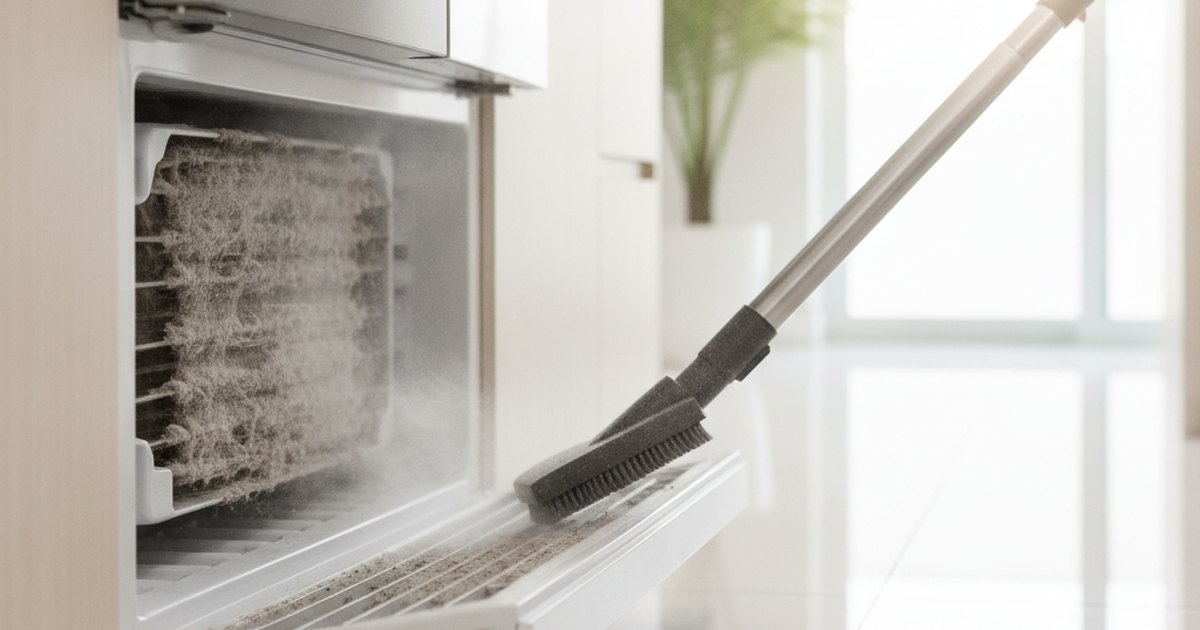
How to Clean Refrigerator Coils (and Why It Matters in Miami)
Cleaning your refrigerator condenser coils is the single most valuable piece of appliance maintenance you can do, and it takes about twenty minutes. Dirty coils cannot release heat, so the compressor runs longer and hotter, your energy bill rises, and the appliance ages faster. In Miami, where fridges already work hard, this one job meaningfully extends the life of the unit.
What the coils actually do
The condenser coils release the heat pulled out of the fridge interior. When they are coated in dust, pet hair and kitchen grease, that heat has nowhere to go. The compressor compensates by running longer, sometimes almost continuously. That is why a fridge with dirty coils feels warm at the back, runs noisily, and struggles to hold temperature in summer.
Where to find them
- Underneath, behind the toe grille at the bottom front. Most common on modern units.
- On the back panel of the fridge. Typical of older models.
- Behind a rear access panel at the base, common on built-in and professional units such as Sub-Zero.
How to clean them, step by step
- Unplug the refrigerator. Not optional. You will be working near a fan and electrical components.
- Locate and remove the grille or panel. Most snap off or come away with a couple of screws.
- Vacuum the loose debris with a narrow crevice tool. Take off the surface layer first.
- Use a coil brush to reach between the fins. A long flexible refrigerator coil brush costs very little and does what a vacuum alone cannot.
- Vacuum again to collect what the brush released.
- Clean the condenser fan blades gently if you can reach them. Dust on the blades reduces airflow badly.
- Wipe the floor underneath, refit the grille, and plug the unit back in.
Do not use water or spray cleaner on the coils, and do not bend the fins. If the coils are sealed behind a panel you cannot easily remove, particularly on built-in units, leave it to a technician rather than forcing anything.
How often, in South Florida
The usual advice is every six to twelve months. In Miami we suggest every six months as a baseline, and every three to four months if you have pets that shed, if the fridge sits in a garage, or if the kitchen sees a lot of frying. Garage refrigerators in particular collect dust quickly and already run hard against summer heat.
What you should notice afterwards
- The compressor cycles off more often instead of running constantly
- The back or base of the unit runs cooler
- Interior temperatures hold more steadily, especially during hot afternoons
- The unit is quieter
- Ice production improves if you have an ice maker that had been slowing
When clean coils do not fix it
If the fridge still will not hold temperature after a proper coil clean, the likely causes are a failing condenser fan motor, a blocked defrost drain, a failed evaporator fan, a door seal letting warm air in, or low refrigerant. A fridge that is cold in the freezer but warm in the fresh food compartment is usually an evaporator fan or defrost fault, not a dead compressor, and that distinction is the difference between a repair and a replacement.
Frequently asked questions
Do all refrigerators have coils you can clean?
Most do. Some newer models have sealed or foam-encased condensers that are not user-serviceable. If there is no accessible grille or rear panel, check the manual before removing anything.
Will cleaning the coils lower my energy bill?
Usually yes. A compressor running longer than necessary uses noticeably more electricity, and refrigerators run continuously, so small inefficiencies add up over a year.
Can dirty coils stop a fridge cooling completely?
They can. Severely clogged coils cause the compressor to overheat and shut down on thermal overload, which looks exactly like a dead fridge.
Is it worth paying someone to do this?
For most people it is a straightforward job worth doing yourself. For built-in or professional units such as Sub-Zero, Wolf or Viking, where panels and cabinetry are involved, it is usually part of a scheduled service visit.
Fridge still struggling?
If your refrigerator is not holding temperature after a coil clean, we can diagnose the fan, defrost system and seals. See refrigerator repair in Miami or freezer repair, and call (786) 733-9343.
For efficiency guidance, ENERGY STAR publishes information on refrigerator energy use and maintenance.